

How clinical trials work
The pathway that takes us to tomorrow’s treatments
Clinical trials help us learn more about ways to prevent or treat medical conditions. Research must show a study drug is safe and effective before it can be approved for use outside of clinical trials. Without these clinical research studies and the volunteers who take part in them, modern medicine would not exist.
We first test a study drug with a small group of clinical trial participants to understand its safety. If the safety is acceptable, we then test the study drug with a larger group of people to understand the efficacy while continuing to monitor safety. There are four main phases of clinical trials.
There are four main phases of clinical trials

As a participant in a phase 1 clinical trial, you’ll help researchers understand the safety of a study drug. You may have frequent clinical examinations and lab work and will be asked to report any issues or side effects.
- 20-100 participants
- 1 week to several months

By joining a phase 2 clinical trial, you’re helping researchers better understand how well the study drug may work for the condition being studied and the side effects that may occur.
- As many as several hundred participants
- 1-2 years on average


In a phase 3 clinical trial, you’ll be part of a larger group of people with the medical condition being studied. Your participation helps researchers determine whether the study drug is safe and effective for people with that condition. This is the phase of study that often helps determine if a drug will be approved for use outside of clinical trials.
- Several hundred to several thousand participants
- 1-4 years on average

Even after drugs are approved for use, you can continue to participate in long-term clinical studies designed to better understand the effects of the approved drug over time.
- Typically several thousand participants
- More than a year

Submission


Review

Approval

Available to people with the condition
How clinical trials are designed
Protocol
Clinical trials start with a protocol. A clinical trial protocol is a detailed plan that explains the purpose of the clinical trial and how it will be run. It includes:

the length of the clinical trial

information about who can participate

the study drugs, procedures and tests in the clinical trial

how side effects will be tracked, managed and reported

the schedule of study activities

the rules that must be followed
The protocol will also describe whether the clinical trial:
- uses randomisation
- is controlled
- uses blinding
Randomisation
Participants are assigned to different treatment groups in a clinical trial by a process called randomisation. Randomisation means that participants are assigned to a treatment group by chance (like flipping a coin) rather than by choice.
Randomisation is one way to help avoid bias in a clinical trial. For example, it helps ensure that people of the same sex or age are not all assigned to the same treatment group.
Controlled trial
A controlled trial is a clinical trial that includes a comparison (control) group. In controlled clinical trials, participants are put into groups that receive the study drug(s) or a 'comparator'. We learn about the effectiveness and safety of the study drug by comparing the experiences of the participants who receive the study drug with those who receive the comparator.
A common example of a comparator is standard-of-care treatment, an established treatment that is currently used for a condition.
In a 'double-blind' controlled trial, placebos are used to prevent the participant and study team from knowing whether the participant is receiving the study drug or the comparator. A placebo does not contain any active ingredients, but the study drug and placebo look alike. Learn more about single-blind and double-blind trials below.
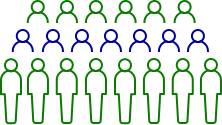
Participants


A computer randomly assigns each participant to one of two or more groups to prevent bias

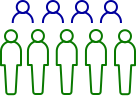
Investigational group receives study medicine
Control group receives comparator
Single-blind, double-blind or open-label clinical trials
Clinical trials could be single-blind, double-blind or open-label.
In a single-blind trial, the participants do not know whether they are receiving the study drug or placebo, but the researchers know.
In a double-blind trial, neither the participants nor the researchers know whether the participants are receiving the study drug or placebo. (If necessary, such as for a safety reason, the researchers can find out what a participant has received.)
In an open-label trial, both the participant and the study doctor will know which treatment the participant is receiving.
Clinical trials use blinding to help prevent bias. This way, the awareness of which treatment group a participant is in does not influence the participant or the study team.
Blinded clinical trials are 'unblinded' after they are complete or when blinding is no longer necessary. When a clinical trial is unblinded, the assigned treatment group for each participant is revealed.
MEVPRO Clinical Trials

Steps to join a clinical trial
Protecting your safety and privacy
FAQ
 English (Australia)
  English (UK)
  English (Canada)
  French
  Greek
Greek  German
  Hungarian
  Dutch (Netherlands)
  English (Finland)
  Swedish
  Polish
  English (Taiwan)
  English (New Zealand)
  Danish
  Bulgarian